A twenty-year journey recorded in steel

The Wrangel Campaign Saber

The service history of a Prussian cavalry saber associated with Lieutenant General August Friedrich Ludwig Freiherr von Wrangel, from the Polish campaign of 1794 to Paris in 1814.

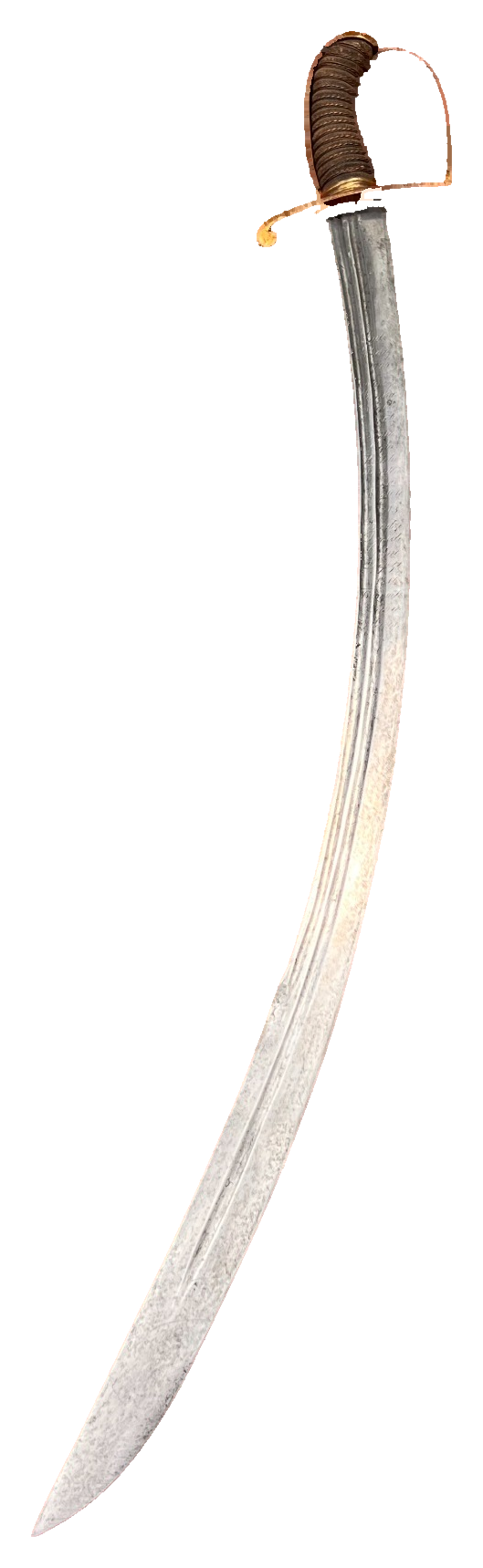
The unsheathed Wrangel Campaign Saber, showing the complete curved blade and hilt

1794 1806 1813 1814

The object

This is more than a named officer’s saber. Its blade functions as a surviving campaign record—documenting where the sword went in the service of Ludwig von Wrangel.
1794Name and opening date
20 yearsCampaign chronology
4Recorded campaign eras
1 bladeA continuous witness

The inscription

A biography of the saber, cut into its blade

The faint script begins with “Ludwig von Wrangel 1794” and continues in chronological order through the campaigns associated with Wrangel’s service. Read as a whole, the inscription does not merely decorate the weapon: it records the sword’s own movement through the defining campaigns of its owner’s career.

Its opening date follows Wrangel’s six years at the Ecole-Militaire in Berlin and his 1793 entry into Prussian service. Its concluding place, Paris, marks the endpoint of the Allied campaign that brought Napoleon’s empire to its first collapse. The sequence reads as the biography of the weapon itself: where this saber was carried in Wrangel’s service.

“Ludwig von Wrangel 1794” The faint name and opening date on the blade. An unretouched evidence photograph. Recessed strokes retain dark material below the more recently cleaned high surface.
The campaign sequence A stitched, full-length record of the inscribed places and dates. One of the overlapping evidence photographs used to follow the campaign sequence down the blade.

Reading the steel

What the surface can tell us

The blade preserves physical relationships between its recessed lettering, the surrounding steel and later cleaning. Those relationships are evidence: they can establish sequence even when they cannot, by themselves, provide an exact calendar date.

Deposits protected inside the engraving Dark material survives in the recessed strokes below the abraded high surface. The photograph documents surface relationships; laboratory analysis would be required to identify the material and establish a defensible chronology.
01

Engraving before cleaning

Later polishing acts first on exposed high surfaces. Here, the broad blade surface carries longitudinal abrasion and cleaning traces while the deepest portions of the letters retain darker material. Where a later cleaning trace crosses the shoulder of an engraved stroke, the cut necessarily existed before that cleaning episode.

02

Protected deposits

The protected recesses contain dark deposits and corrosion products that were not removed when the surrounding surface was cleaned. Their survival is consistent with an inscription older than the latest cleaning. The deposits are valuable evidence and should not be picked out, polished, oiled heavily or chemically treated before examination.

03

What photographs cannot date

Photography supports a relative sequence—engraving first, latest cleaning later—but it does not date the strokes to 1794 or identify the particles. A defensible material conclusion requires examination by a qualified arms conservator or metallurgical laboratory.

Military education · 1787–1793

The Berlin Académie militaire

Henry von Baensch’s 1887 Geschichte der Familie von Wrangel records that King Friedrich Wilhelm II ordered the thirteen-year-old Wrangel into the Ecole-Militaire in Berlin on 10 May 1787. He remained there until 1793, immediately before beginning his commissioned Prussian service.

The Prussian institution

Berlin · Burgstraße 19

This was a real Berlin academy, opened by Frederick II in 1765 and known as the Académie militaire, Académie des nobles, or Royal New Knights’ Academy. In Wrangel’s period it stood at Burgstraße 19 opposite the Berlin Palace and prepared young nobles for Prussian military and state service.

Read the institutional history ↗
The language of the name

A French title in Prussian Berlin

French was a language of court, diplomacy and elite education in Frederickian Prussia. The academy employed teachers from France and taught French alongside history, geography, mathematics, engineering and fortification, philosophy, law, drawing, fencing, riding, dancing and drill. The French title identifies Berlin’s cosmopolitan Prussian academy; it does not place the school in Paris.

Open the 1887 family history ↗
The Berlin school recorded in the Wrangel family history The controlling biographical passage: “am 10. Mai 1787 in die Ecole-Militaire zu Berlin.” Printed page 787 also records his 1793 infantry appointment, transfer to the von der Trenck Hussars and service in the Polish campaign. Henry von Baensch, Geschichte der Familie von Wrangel, 1887, p. 787; National Library of Estonia

The campaign record

From Prussia to Paris

The chronological inscriptions turn a military weapon into a material itinerary of the Revolutionary and Napoleonic era.

1

1794

Błonie & Warsaw

The saber’s dated beginning coincides with Wrangel’s service in the Polish campaign, including Błonie and the fighting before Warsaw.

2

1806

Pułtusk

Wrangel fought at Pułtusk on 26 December 1806 and received the Pour le Mérite on 31 December, together with the Russian Order of St. Anne.

3

1813

Leipzig

At Leipzig, 16–19 October 1813, he commanded the reserve cavalry of the Prussian II Army Corps.

4

1814

The Road to Paris

The campaign record continues through France and concludes at Paris—the political and military endpoint of the 1814 campaign against Napoleon.

Pułtusk, 26 December 1806 A battle plan contextualizing Wrangel’s service at Pułtusk. Diagram showing the approximate positions around noon. The map is replaceable in the Customizer without changing this metadata. Andrew Hobley, based on F. L. Petre and David Chandler; public-domain dedication via Wikimedia Commons
Leipzig, 16–19 October 1813 The Battle of Nations, where Wrangel commanded reserve cavalry of the Prussian II Army Corps. Map of the dispositions on 18 October, reproduced from Meyers Konversations-Lexikon. Meyers Konversations-Lexikon, 4th ed. (1885–1890); public domain via Wikimedia Commons
Paris, 30–31 March 1814 Paris marks the concluding place in the saber’s campaign record. The site distinguishes reaching and entering Paris from a claim that Wrangel’s brigade fought in the main battle on 30 March. The printed date uses the Russian Julian calendar. Nineteenth-century Russian battle plan, modified by Vissarion; public-domain dedication via Wikimedia Commons
August Friedrich Ludwig Freiherr von Wrangel Portrait reproduced in the 1887 Wrangel family history, printed page 787. Replace only with an image verified as this Ludwig von Wrangel, not his younger brother Friedrich. Henry von Baensch, Geschichte der Familie von Wrangel, 1887, p. 787

The officer

Lieutenant General Ludwig von Wrangel

1774–1851 · Prussian cavalry officer

Born at Schloss Pollnow, Wrangel completed six years of military education between 1787 and 1793. After a brief infantry appointment, he transferred at his own request to the von der Trenck Hussars as a cornet on 7 September 1793.

His career extended from the 1794 Polish campaign through Pułtusk, Leipzig and the 1814 campaign in France. He became a royal wing adjutant for cavalry, a divisional commander, a lieutenant general and governor of Königsberg before retiring in October 1832.

His advancement was accompanied by unusual royal trust. The archival record places him in Russian General Bennigsen’s headquarters in 1806–07 and preserves passes, diary material, reports, memoranda and communications to King Friedrich Wilhelm III. By 1809 he served as a royal wing adjutant for cavalry; in 1813 he commanded the reserve cavalry of the Prussian II Army Corps at Leipzig.

31 Dec 1806
Pour le Mérite
1806
Order of St. Anne
1813
Reserve cavalry, II Corps

Confidential service

The secret mission of 1812

Wrangel’s service included confidential political-military work at the moment Prussia was trapped between formal alliance with Napoleon and the growing possibility of liberation through Russia.

The mission is not modern folklore. Historian Friedrich Thimme devoted a documentary study to “Die geheime Mission des Flügeladjutanten von Wrangel 1812” and paired it with a study of “Freiherr Ludwig von Wrangel und die Konvention von Tauroggen.” Together, those titles place Wrangel within the concealed diplomacy and military intelligence surrounding Prussia’s change of course in 1812.

Scarcity & survival

An extraordinarily scarce form of military memory

Period officer sabers survive. Named presentation swords survive. Decorated blades survive. What is extraordinarily scarce is their convergence here: a saber naming a senior Prussian officer, carrying a dated beginning, and preserving a chronological record of campaigns across two decades on the blade itself.

Within the auction, museum and private-collection records reviewed for this project, no exact parallel has yet been identified with this same combination of named ownership, duration, sequence and historical reach. This does not assert that another cannot exist; it establishes that close comparables are exceptionally difficult to locate.

NamedThe owner is identified on the blade.
DatedThe record opens in 1794.
SequentialCampaign places unfold chronologically.
ContinuousThe record spans the rise and fall of Napoleonic power.

Family provenance

Preserved, researched, passed forward

A continuous custodial account retained so the next keeper receives the fullest surviving history.

  1. 1794Presented to Wrangel

    Given by his parents following his military education and entry into active cavalry service.

  2. Family custodyThe Baltic branch

    Presented to Wrangel by his parents in 1794 following his military education and entry into active cavalry service. Preserved within the extended Wrangel family and brought to the United States by two sisters after the Second World War.

  3. American marketFrom family to trade

    Sold by the husband of one of the sisters to an antique shop, then passing through two purchases before Patrick A. Wilder acquired it.

  4. ResearchPatrick A. Wilder

    War of 1812 historian Patrick A. Wilder traced Reverend Carola von Wrangel in Troy, New York; she confirmed the family account. The saber later passed from Patrick Wilder to Hans Wilder and the Wilder Historical Collection.

The Baltimore loss

The original written provenance was stolen at an antique arms show in Baltimore, Maryland, in 2023. This site preserves the surviving account, research trail and physical evidence while renewed documentary research continues.

Archival context

A family tradition of preserving campaign arms

The Wrangel family archive supplies an important parallel. A surviving metal label associated with a pair of Ludwig von Wrangel’s pistols states that he carried them in the campaigns of 1806, 1807, 1813 and 1814. The archive demonstrates that his campaign weapons—and their service histories—were deliberately preserved within the family.

Open the official archive finding aid ↗
Wrangel campaign-weapons label Family-archive evidence for the preservation and labeling of Wrangel’s campaign arms. Reserved for authorized photography supplied by the Geheimes Staatsarchiv Preußischer Kulturbesitz. GStA PK, XX. HA, FA Wrangel v., Nr. 39
Family history & biography

Henry von Baensch, Geschichte der Familie von Wrangel (1887), printed p. 787. The controlling source for the Berlin academy and early service chronology.

Berlin military academy

The Prussian Académie militaire or Académie des nobles opened in 1765 and occupied Burgstraße 19 during Wrangel’s attendance.

Family archive

Geheimes Staatsarchiv Preußischer Kulturbesitz, XX. HA, FA Wrangel v., including files 6, 10, 11, 33, 39, 40, 49 and 53.

Campaign-weapons evidence

Archive file 39 records a family label stating that Lieutenant General Ludwig von Wrangel carried pistols in the campaigns of 1806, 1807, 1813 and 1814.

Private acquisition

A singular record offered intact

The saber, scabbard, research dossier and surviving provenance record are offered together by the Wilder Historical Collection. Serious institutional and private-collection inquiries are welcome.

Private offeringOffers invited

Submit a direct offer for consideration. Any transfer remains subject to inspection and mutually agreed terms.

Make an offer

Private offer

Make an offer for the Wrangel Campaign Saber

Use this private form to submit an offer for consideration. Include your proposed amount and any terms you would like reviewed.